abstract plus signs wave pattern

Pharmaceutical Validation for Expansion and Scale

Where expansion strategy meets validation discipline to protect commercialization timelines as production scales.

Get Started with Medix Life Sciences

Pharmaceutical Staffing Experience You Can Trust

At Medix, we have decades of experience helping life sciences organizations hire scientific professionals.

20+

Years of Industry Experience

3M+

Specialized candidates in our diverse staffing pool

7M+

Hours of service completed by Medix talent

Why Pharmaceutical Validation Becomes a Business Risk During Expansion

Too often, it’s treated as a compliance requirement. During expansion, pharmaceutical validation determines speed, stability, and inspection readiness. New lines, new equipment, new processes, compressed timelines. Each introduces complexity. And as complexity increases, so does the risk of disconnects between design, execution, and documentation.

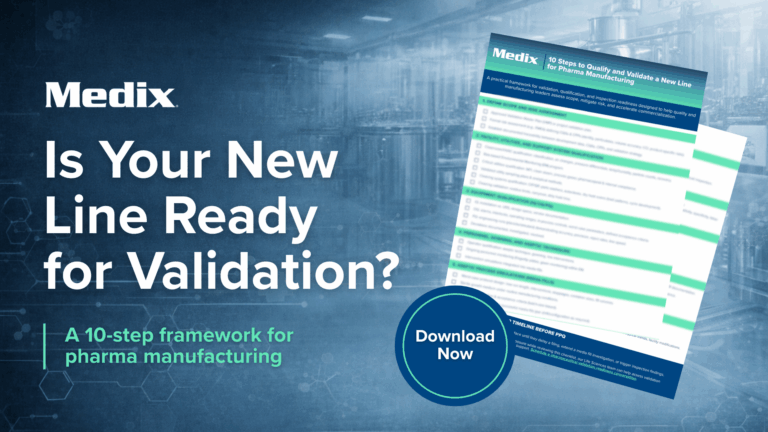
A 10-step guide to help quality and manufacturing leaders assess risk, align scope, and protect commercialization timelines.

Expansion Changes the Rules

Growth Multiplies Complexity

Capacity growth rarely happens in isolation. Organizations are scaling sterile operations, integrating new systems, managing tech transfers, hiring and onboarding new teams, and navigating evolving regulatory expectations. Each variable affects validation—even when it doesn’t look like it on paper.

Alignment Protects the Timeline

Strong validation isn’t built from isolated activities. It requires clear ownership, defined risk tolerance, alignment between development and manufacturing, governance beyond initial qualification, and visibility across quality systems. When these elements align, validation supports speed. When they don’t, timelines slip.

5 Ways Expansion Quietly Derails Validation

Validation rarely fails dramatically. It drifts most often when complexity outpaces control. Individually these are minor, but collectively disruptive.

Get Started with Medix Life Sciences

Scope expands without recalibration

Documentation lags behind execution

Teams operate with different assumptions

“Temporary” workarounds become normalized

Change outpaces governance

How Leading Teams Protect Validation During Expansion

As expansion accelerates, protecting validation requires intentional structure—not just documentation.

Right-size validation capacity to the pace of change

Commissioning, ramp-up, and regulatory preparation often overlap. Capacity must match complexity.

Align ownership across quality, manufacturing, and engineering

Clear accountability prevents scope drift and assumption gaps.

Prioritize execution discipline—not just documentation completeness

Validation strength is determined by how consistently protocols are executed under pressure.

The Cost of Validation Gaps During Expansion

Validation Audit Icon

As pharmaceutical organizations expand capacity, validation requirements often grow faster than internal resources. New equipment, facility expansions, technology transfers, process changes, and increased production volumes all increase the need for specialized validation support.

When validation capacity doesn’t keep pace with expansion, the consequences can extend beyond compliance. Validation gaps may contribute to audit observations, remediation efforts, delayed production readiness, postponed product launches, and increased regulatory scrutiny. Aligning validation expertise with the pace of growth helps organizations protect commercialization timelines while maintaining quality and inspection readiness.

Trusted for Expertise. Proven in Partnership.

For over 20 years, Medix Life Sciences has delivered the expertise pharmaceutical and biotech organizations rely on to validate, scale, and sustain critical production systems.

Get Started with Medix Life Sciences

“Medix has been a true partner, working closely with us to deliver the resources and expertise we need. Their commitment to understanding our strategic goals and supporting us wherever needed has made a real difference.”

Medix Client

“The team really listened to my needs and found the right fit for what I was needing during the project. Everyone was very proactive, professional, and excellent at communicating with me.”

Medix Client

“Medix helped us staff a series of launches in multiple states allowing us to successfully launch on time. These positions were difficult to fill and Medix did it fast with great people.”

Medix Client

Pharmaceutical Validation FAQs

Pharmaceutical validation is the documented process of establishing evidence that systems and processes consistently produce product meeting predetermined quality attributes and regulatory expectations.

Pharmaceutical validation typically falls into four categories: process validation, cleaning validation, analytical method validation, and computer system validation (CSV). Process validation ensures manufacturing processes consistently produce quality products. Cleaning validation confirms equipment is free from contaminants and cross-contamination risks. Analytical method validation verifies laboratory testing methods are accurate, reliable, and fit for purpose. Computer system validation ensures software and digital systems function as intended and maintain compliant, traceable data. Together, these validation activities help manufacturers maintain product quality, regulatory compliance, and audit readiness.

Installation Qualification (IQ) verifies installation against approved specifications. Operational Qualification (OQ) challenges operating ranges and controls. Performance Qualification (PQ) confirms consistent performance under routine conditions.

The lifecycle includes process design, process qualification (including Process Performance Qualification, or PPQ), and Continued Process Verification (CPV).

Process validation in pharma typically includes four key approaches. Prospective validation confirms a process can consistently meet quality standards before commercial production begins. Concurrent validation evaluates performance during routine manufacturing when real-time data collection is needed. Retrospective validation uses historical production data to demonstrate process consistency, though it is less common under current regulatory expectations. Revalidation is conducted when significant changes to processes, equipment, facilities, or quality systems occur to ensure continued compliance and performance.

Regulatory guidance generally expects at least three consecutive commercial-scale batches, though justification may vary based on product risk and prior knowledge.

21 CFR validation refers to meeting FDA regulatory requirements for pharmaceutical manufacturing, including electronic records, data integrity, and current Good Manufacturing Practices (cGMPs). It involves validating systems, equipment, and processes through activities such as IQ, OQ, and PQ to ensure they consistently perform as intended. Proper documentation is essential to demonstrate compliance, maintain audit readiness, and support product quality.

Revalidation may be triggered by equipment changes, Environmental Monitoring excursions, process modifications, sterility failures, facility changes, or atypical trending. Failure to maintain validated states can increase the risk of audit observations, remediation efforts, production delays, and regulatory scrutiny.

Expansion initiatives, facility upgrades, technology transfers, and production scale-ups often create additional validation demands. Supplemental staffing provides access to specialized validation, quality, engineering, and compliance talent that can support activities across Process Design, Process Qualification (PPQ), and Continued Process Verification (CPV), helping organizations maintain compliance while protecting commercialization timelines.

Facility expansions often require validation engineers, CQV specialists, and quality engineers. Equipment implementations may also require automation and process engineering support. Tech transfers and PPQ activities frequently rely on cross-functional validation, quality, and manufacturing teams, while Continued Process Verification (CPV) typically emphasizes ongoing quality, compliance, and process monitoring expertise.

Strengthen Expansion With Confidence

Partner with Medix Life Sciences to align validation expertise with manufacturing growth. From commissioning support through sustained oversight, we help protect commercialization timelines while maintaining inspection readiness.

Get Started with Medix Life Sciences